A Checklist or a Calendar Block for a New Habit?
Choose a checklist or calendar block for a new habit based on its timing, reminders, flexibility, and recovery after missed days.
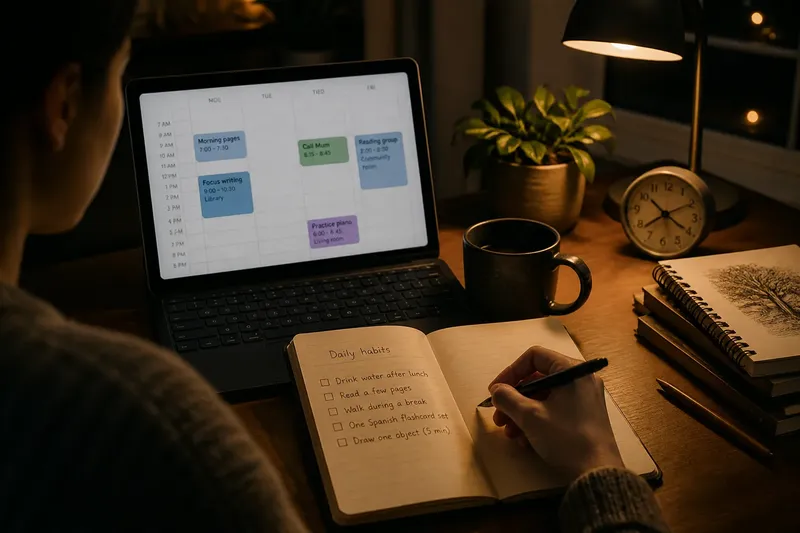
Should a new habit live on a checklist or in your calendar? The best format depends on what the habit needs: a visible cue, protected time, or room to move when the day changes. A checklist makes completion easy to see; a calendar block reserves a place to act. For many habits, one will do the job better than the other.
Checklist or calendar block?
Use a checklist when the habit can happen at a convenient point in your day and you mainly need to remember whether you did it. Use a calendar block when the habit needs a particular time, a stretch of uninterrupted attention, or a deliberate boundary against other demands.
The difference is simple: a checklist tracks an action; a block gives that action a time and space. Neither format creates motivation on its own. Choose the one that removes the most friction from the next attempt.
- Choose a checklist for a small, flexible action that can fit around ordinary routines.
- Choose a calendar block for an action that needs a setting, a session, or protection from competing plans.
- Combine them when you need both a reserved time and a clear record of completion.
Flexible habits
A checklist fits habits without a meaningful appointment time. Drinking a glass of water after lunch, writing down one question from a book, or taking a short walk during a break can happen when an opening appears. A checkbox gives you a small prompt and a clear way to mark the action done without deciding in advance exactly when it must happen.
Keep the list short and specific. “Practice Spanish” can feel too broad to check off; “review one set of Spanish flashcards” names an action you can recognize as complete. Put the list where you will naturally see it, such as a paper notepad beside your lunch spot or a notes app you already open during the day.
A checklist can also suit habits whose timing changes from day to day. If your work schedule shifts, a list can travel with you without requiring a round of calendar edits. It records whether you acted, not whether you followed a rigid timetable.
Time-sensitive habits
A calendar block is the stronger fit when the habit depends on a particular window. Calling a relative before their workday starts, attending a class, or making time for a focused writing session all benefit from a visible slot. The event can remind you and signal to other people that the time is already spoken for.
Make the block concrete enough to start. “Work on music” is hard to act on; “open the keyboard and practice the song passage” gives the session a first move. Add a location or a small preparation note if that helps: “library desk” or “bring notebook” can prevent a separate search when the time arrives.
Protect the block from becoming a promise to do more than the available time allows. If an action regularly expands, define a modest session with a clear stopping point. A calendar entry should make starting easier, not turn an ordinary habit into an appointment you dread.
Reminders and visibility
Ask where you are most likely to notice the cue. A paper checklist can work well if it sits beside an object tied to the habit, such as a sketchbook on your desk. A calendar notification may work better if you already check your phone or computer to manage the day.
Use one reliable reminder rather than scattering prompts across several apps, sticky notes, and alarms. Too many cues can become background noise, while a checklist hidden in a drawer cannot remind you at all. If you ignore a notification, change its timing or attach the habit to a more visible place instead of adding another alert.
For a habit that is easy to forget but has no fixed time, put a short reminder on the checklist itself: “after lunch” or “before I close the laptop.” That gives the action a cue without requiring a formal calendar appointment.
Flexibility and missed days
A checklist is usually more forgiving when the day changes. You can complete the action later without treating a missed time as a failure. A calendar block can be moved, but repeated rescheduling may leave the habit looking like a series of unfinished appointments.
Decide in advance what a missed day means. It can mean only that the action did not happen that day. Keep the next opportunity visible, and avoid adding overdue boxes or doubling the next session as punishment. The useful question is what would make the next attempt easier: a clearer cue, a shorter action, or a different time.
Say you want to sketch regularly, but your evenings vary. You put “draw one object for five minutes” on a checklist beside your sketchbook and leave it unchecked on a busy day. The next time you pass the desk, the small action is still clear; the list does not demand that you recover a missed appointment.
Choose by situation
Sort the habit by its main obstacle rather than choosing a format because it looks more organized. If forgetting is the problem, make the cue visible. If other plans keep taking the time, reserve a block. If the habit has both problems, use both formats in distinct roles.
- The habit can happen anytime: use a checklist, because it tracks completion without forcing an arbitrary hour.
- The habit depends on a specific window: use a calendar block, because the time itself is part of the plan.
- The habit needs a longer stretch: use a calendar block, because a reserved session helps you avoid relying on leftover minutes.
- The habit is easy to forget but quick to do: use a visible checklist with a cue tied to an existing routine.
- Your schedule changes often: start with a checklist, unless the habit has a real deadline or appointment.
- You need a reminder and a record: block the time, then mark completion on a short checklist rather than duplicating every detail.
Imagine you want to read a few pages for enjoyment, but the best time changes each day. A checklist in the book can keep the action visible without assigning it a fixed hour. If you instead need to attend a weekly reading group, put the meeting in your calendar: the time and place are part of the habit.
Format questions?
Can I use both a checklist and a calendar block?
Yes, if each has a separate job: let the calendar protect the time and the checklist record whether you completed the action. Avoid copying the same notes and reminders into several places, which can make the system harder to maintain than the habit.
Should a checklist reset every day?
Use a daily list when the action makes sense each day, and a weekly list when the habit has a flexible rhythm. Choose the period that matches the actual commitment, so a blank box means something clear rather than looking like a missed deadline.
What if my calendar blocks keep moving?
If the habit does not require a particular time, switch to a checklist or give it a broad cue such as “after work.” If it does require a time, pick a more realistic window and make the session small enough to fit the schedule you actually have.
Which format works without phone reminders?
A paper checklist can sit where the action happens, while a paper planner can hold a time block. Choose the physical location you are likely to see; a beautifully organized page that stays in a closed drawer will not serve as a useful cue.
Keep the system light
Start with the format that fits the habit’s main obstacle, then use it for a short trial period in ordinary life. Notice only practical signals: whether you saw the cue, whether the action fit, and whether a missed day made restarting awkward. Change the format if it adds more management than help.
What is not worth the effort is decorating a tracker, color-coding every habit, or building a complex app system before you know what reminder you need. A single line on a notepad or one clear calendar entry is often enough to begin. For a new habit, choose a checklist or calendar block that makes the next action obvious—and adjust it when your routine gives you a reason.