Why Spacing Practice Helps a Skill Take Shape
Spacing practice gives a skill room for recall and adjustment. Learn how to choose session lengths, handle forgetting, and make each return useful.
How do you make practice stick when a skill still feels awkward? Spacing practice across separate sessions gives you a fresh chance to recall what you learned, notice what needs adjusting, and try again without turning every attempt into a marathon.
The point is not to follow a perfect schedule. It is to leave enough room between attempts for the next session to ask something of you, while keeping each session focused enough that you can tell what happened.
Let a session end
When a guitar chord, a sketching technique, or a new phrase in another language is still unfamiliar, it is tempting to repeat it until the movement feels smooth. Repetition can help, but a long run of near-identical attempts can blur together. You may finish tired without knowing which part improved or which part still needs attention.
A pause changes the next attempt. You have to bring the movement or idea back rather than simply continue the same stream of repetitions. That small act of recall can reveal where the skill is secure and where it remains dependent on a prompt, a model, or a lucky first try.
Ending a session before attention collapses also makes it easier to observe details. If you are practicing a watercolor wash, for instance, you can focus on how much water is on the brush and how the paper responds. Repeating after you have stopped noticing those details is less useful than putting the brush down and returning with a clear question.
Choose a useful gap
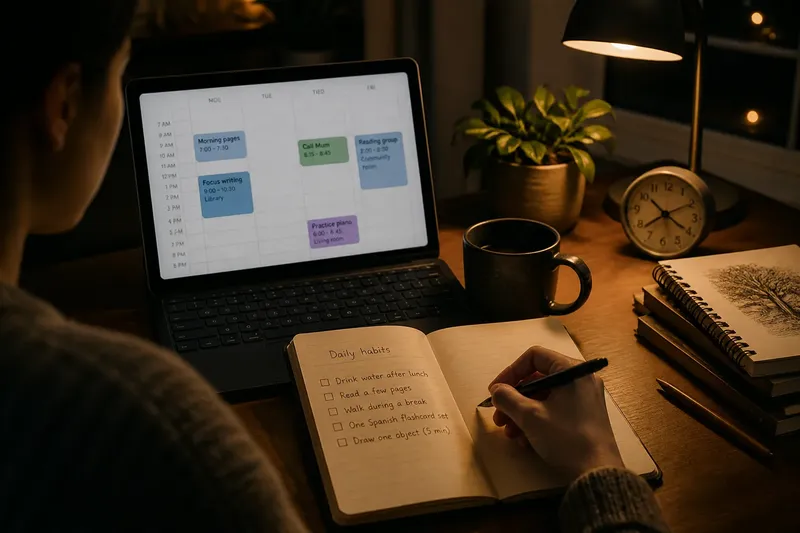
There is no single interval that suits every skill or learner. A gap should be long enough that you cannot rely entirely on immediate repetition, but not so long that you have no idea what to try when you return. Start with a gap that fits your ordinary routine, then adjust based on what the next session feels like.
If you can repeat the skill only by copying the last attempt step for step, try a somewhat longer pause next time. If the pause leaves you unable to recall the basic aim, make the next return sooner or leave yourself a brief cue. The cue should prompt memory, not replace the effort of bringing the skill back.
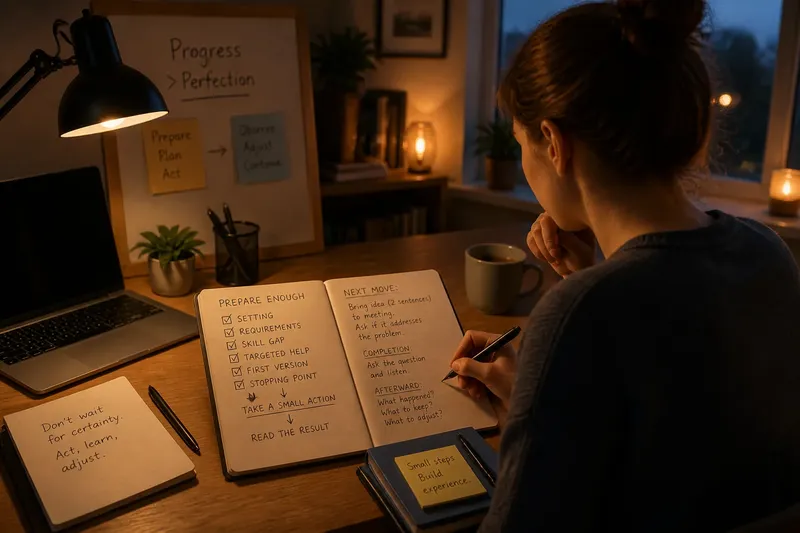
A notebook can make that adjustment concrete. After practicing, write one line such as “keep the wrist loose on the downstroke” or “check the verb ending before speaking.” At the next session, try first without reading the note; consult it only if you get stuck. This preserves a chance to recall while keeping the next action clear.
Give each return a question
Coming back to a skill is more useful when you know what to observe. A broad intention like “get better at drawing” can lead to scattered effort. A small question—“Can I keep the window frame parallel?”—gives the session a visible target and helps you decide what to change.
Use one focus at a time when a skill has several moving parts. For a short spoken presentation, one session might attend to the opening sentence; another might focus on pauses between ideas. This is not a rule that every skill must be split into isolated pieces. It is a way to avoid trying to fix delivery, wording, timing, and posture all at once.
Say you are learning to make a clean cut with a kitchen knife while preparing vegetables. In one session, you notice that the pieces vary because your grip shifts; you jot down “steady the guide hand.” At the next session, you return to the same vegetable and focus on keeping that hand position consistent. The observable result to look for is more uniform pieces, not a claim that the skill is finished.
What should a return session include?
Should you warm up first?
If the skill requires equipment or a sequence of movements, begin with an easy attempt that helps you orient yourself. Then move to the part that needs attention; do not let familiar warm-ups consume the whole session.
Should you repeat the same task?
Repeat it when consistency is the issue, but vary the conditions when you need to learn how to adapt. A language learner might practice the same phrase with different subjects, while a sketcher might draw a similar object from another angle.
What if you forget the next move?
Try to recall the first step before checking a note or demonstration. If you remain stuck, use the smallest prompt that gets you moving, then make a short note about what was missing so you can revisit it later.
When should you stop for the day?
Stop when attention is no longer helping you notice or correct the detail you chose to practice. A clear stopping point can be finishing a deliberate attempt and recording what you want to check next time, rather than chasing an arbitrary number of repetitions.
Keep feedback small
Practice needs feedback, but feedback does not have to be elaborate. Listen for whether a piano note rings cleanly, compare a sentence you wrote with the intended meaning, or look at whether a stitched seam follows the line you marked. Choose an observable feature that belongs to the task.
When you cannot judge the result yourself, ask a teacher, peer, or knowledgeable friend for one specific observation. “What should I focus on in this passage?” is easier to use than an open request for a general verdict. If you use a video or audio recording, review only the segment tied to your question so the tool serves the practice rather than distracting from it.
It is not worth the effort to record every attempt, buy a special tracking system, or analyze tiny fluctuations after each session. A scrap of paper and a brief cue may be enough. Add more structure only if it helps you return to the actual skill.
Notice the kind of progress
Early improvement may look like recognizing an error sooner, remembering the first move without a prompt, or recovering after a mistake. Those changes can be easy to miss if you judge every session only by whether the result looks polished.
Keep a small record of what you attempted and what you noticed, not a score that makes each session feel like a verdict. When you review the notes, look for a next useful question: Is the old prompt still needed? Does the task become unstable when one condition changes? Which part now deserves attention?
Spacing practice works best as a pattern of return, recall, observation, and adjustment—not as a demand to practice every day or follow a fixed timetable. Choose a manageable task, leave a useful cue, and come back when you can give it attention. The next session can begin with one honest attempt and a detail you are ready to notice.