A Sunday Evening Review for a Crowded Week
A Sunday evening review for a crowded week helps you sort fixed commitments, movable tasks, and things that can wait, then choose one realistic priority.
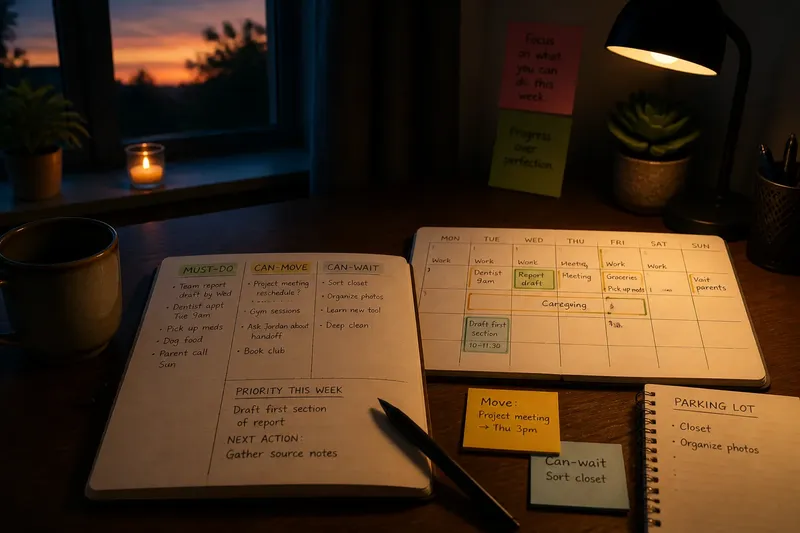
What can you realistically take on this week, and what needs to move? A Sunday evening review for a crowded week gives you a short, repeatable way to sort commitments into must-do, can-move, and can-wait groups, then choose one priority that fits the week you actually have.
Keep the review to about fifteen minutes and use a sheet of paper, a notebook, or a blank note on your phone. This is not a new planning system. It is a pause to see the shape of the next few days before every open space starts looking like available work.
Set up the review
Choose a time when you can think without rushing. Sunday evening works for many people, but another quiet point before the week begins is fine. Put your calendar and one place where you collect tasks in front of you; avoid opening several apps and trying to reconcile every old note.
Start by looking at the week’s fixed commitments: work shifts, classes, appointments, caregiving, travel, and other events with a set time. These are not automatically easy or unimportant, but they define the space left for everything else. Include the time needed to get ready or travel when it affects your day.
Next, collect the tasks already on your mind. Write them down in plain language, with a clear action: “send the form” is more useful than “paperwork,” and “ask Jordan about the handoff” is clearer than “project.” Do not add every possible improvement or distant goal. The point is to see obligations already pressing on the week.
Sort the commitments
Give each task one of three labels. Use the label that reflects its actual consequence and timing, not how guilty or uneasy it makes you feel.
- Must-do: A deadline, appointment, promise, or practical need makes action this week necessary. If you delay it, someone may be left waiting, a process may stall, or a basic need may go unmet.
- Can-move: The task matters, but its timing has some flexibility. You can reschedule it, reduce its scope, or agree on a later date without creating a serious problem.
- Can-wait: The task may be worthwhile, but this week does not require it. It can stay off the active list until you review it again.
Be careful not to classify every request as a must-do just because it arrived recently. Check the actual deadline, who is depending on you, and what happens if the work moves. If you do not know, a short message asking for the real due date can be more useful than silently making a guess.
For commitments involving health, finances, legal obligations, or safety, use the relevant professional guidance and official deadlines rather than relying on this informal sorting method. Where a label, manufacturer’s instructions, or local rules determine what is required, follow those requirements.
Choose one priority
After sorting, choose one realistic priority for the week: a piece of work that deserves protected attention and has a clear next action. This does not replace must-do obligations. It gives the week a deliberate focus instead of letting every task compete for the same attention.
Ask three questions. Does this matter beyond the immediate feeling of urgency? Can I name the next visible action? Is there a plausible place for that action among the fixed commitments? If the answer to the last question is no, shrink the task or choose a different priority.
Make the priority specific enough to begin. “Make progress on the application” is vague; “draft the first section” gives you a starting point. You do not need to estimate the entire task or promise yourself a finished result. Decide what a useful first block of attention would produce.
Say you have a crowded week with an appointment, a report due, groceries to buy, and a closet you have been meaning to sort. The report may be a must-do, groceries may need a practical time, and closet sorting can wait. If a draft of the report is the priority, choose a realistic opening action, such as gathering the source notes, rather than pretending the whole week is free for writing.
Make room for reality
Now look at the calendar and place only the actions that need a particular time. Add the report’s first work block, an errand window, or a reminder to contact someone about a movable commitment. Do not schedule every task just to make the week appear controlled. Leave some open space for transitions, delays, and ordinary life.
For a can-move item, decide what “move” means. Pick a new date if that is useful, or write the condition that will bring it back into view, such as “revisit after the appointment.” For a can-wait item, put it in a separate parking note rather than leaving it mixed with this week’s tasks. A task placed somewhere visible can stop demanding attention every time you remember it.
Check the load across the week, not only the total number of tasks. A day with work, a long appointment, and caregiving may have little room for extra effort, even if the rest of the week looks open. Shift flexible work away from that day before adding more to it.
What if plans change?
What if the week is already full?
Keep the fixed commitments and identify which must-do actions have real deadlines. Then move, reduce, or defer the rest, and contact anyone who needs to know about a change. If several important obligations conflict, ask the relevant people to clarify what should take precedence instead of privately assuming you can do everything.
How do I handle a task with no deadline?
Ask whether it serves a current responsibility or a chosen priority. If it does, give it a next action and a reasonable review point; if not, place it in can-wait. A task can matter without belonging in this particular week.
What if I miss my priority?
At the next check-in, find out whether the task was too large, the time was unrealistic, or something more urgent intervened. Carry forward a smaller next action only if it still matters, and make room for it by moving something else. Do not treat a missed plan as evidence that you lack discipline.
Should I plan every hour?
Usually not for this review. Put fixed events and actions that need a time on the calendar, then leave flexible work as a short list. Hour-by-hour planning can create extra maintenance when your week is unpredictable.
Use brief check-ins
On a weekday morning, take a minute to compare the day with the review. Ask whether a fixed commitment changed and identify the next action for your priority. This is a small adjustment, not an invitation to rebuild the whole plan.
Midweek, look again if the schedule has shifted or a new request has arrived. Re-sort only what the change affects. A new must-do may mean moving a can-move task; it does not mean every parked task must be reconsidered.
At the end of the week, notice what needs to carry forward and what can leave the list. If the same task keeps returning, ask whether it needs a smaller first action, a conversation with someone, or a clear decision to stop pursuing it. That question turns repetition into information rather than another reason to feel behind.
Keep the routine light
Use the same three labels each week and keep the notes in one easy-to-find place. If a paper list works, there is no need to build a spreadsheet or create a complicated color system. The review should take less effort than the confusion it replaces.
What is not worth the effort is decorating the plan, rewriting every task into several tools, or trying to predict every interruption. A crowded week rarely becomes simple because its list looks polished. The useful part is deciding what has to happen, what can shift, and what does not need your attention now.
A Sunday evening review for a crowded week works best when it remains small enough to repeat: sort the commitments, choose one workable priority, and leave room for the unexpected. If the week changes, revise the next action rather than demanding that the original plan remain intact.
Before you close the notebook, make sure the first action is easy to recognize and the people affected by a change have been told. Then let the can-wait list stay parked until its next review; remembering a task is not the same as needing to act on it tonight.